Sunday, January 7, 2018

Anchors on Ancient Coins, or which way is up

My interest in ancient anchors is related to my cast bronze collection. I purchased an uncia from Hatria with an anchor on one side and HAT on the other.

Aes Grave Uncia, Hatria, 280 BC (275 – 225 BC)
Obv – Anchor, some coins have an H to the right of the anchor
Rev – HAT surrounding a mark of value, one dot. Some coins have TAH on reverse.
I found 17 examples on line. See statistics below.
Wt = 31 grams; avg wt = 31 g; Min wt = 20.4; Max wt = 50.4; StDev = 6.8
Diameter = 31.5 max and 30.2 min & 7.3 mm thick; avg = 31 mm; Min = 29; Max = 34; StDev = 1.8
Die axis = 12; of the 13 coins I found on line 13 had a die axis of 12 and one had an axis of 6. This is consistent with other aes grave coins I have.
TV – 186
V – 242
HNI – 16
Syd AG – 191
Haberline plate 16, # 13 - 16

I normally do a bit of research before buying a coin and a bit more after the fact. Die rotation is one of the attributes I track. Most cast bronze from Italy have a die rotation of 0o (or 12 o’clock), the second most common rotation is 180 o (or 6 o’clock), and all other positions are less common. I could not tell die rotation for this coin without knowing how the anchor (anker in German) should be viewed.
It looks to me that the direction an anchor points on an ancient coin changes. 
I am not an expert on ancient anchors, but have handled many Widow’s Mites.  
Most of these coins are shown with an “inverted” anchor, or the coin is minted with the point to the top of the coin. Note – inverted is David Hendin’s description of the anchor in Guide to Biblical Coins. 

A recent Agora auction showed an anchor counter mark in the same position: “C/M Seleukid anchor in oval, flukes upward.”
A similar coin from LAC: Seleukis Uncertain date. Athena/Nike, c/m: anchor.

Some other Seleukid anchor coins
I have a couple of Orodes bronze coins with anchors similar to this one above sold by CNG and the ones below sold by LAC.


A few other examples of points up –

 Two Alexander the Great (or his followers after his death) Herc/Zeus coins with an anchor on the coin (from Art Coins Roma), above, and an anchor counterstamp (from Roma), below.

A Brutium coin with an anchor, LAC

Drachms from Thrace have a point up anchor also:
Per CNG the coin above is from Pontika in Northern Greece and was minted in mid-late 4th century BC. The obverse has a facing Gorgoneion and the reverse has an upright anchor.

A similar coin from Artemide Asta
a Corinthian coin from AA has an anchor on the reverse


The Romans put anchors of both Republican and Imperial coins. Several Aes Grave coins have anchors. A Vecchi 160/166, minted in Tuder in 260 – 270 BC has a Frog & Anchor on the obv & rev. The anchor has circles on both ends. The coin was sold by AA.


By 210 BC, bronze coins were struck. The following As has an anchor on the reverse.
Roman Republic, AE, struck As, anonymous, 209 – 208 BC
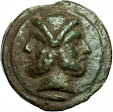
Obv – head of Janus, above mark of value – I
Rev – Prow R, above mark of value – I, before anchor, in ex – ROMA with archaic A (v pointing down)
Cr 50/3
Syd – 145
34.99 g

About the same time, the Romans put an anchor on the reverse of the denarius. In this case the anchor is sideways, but has a connecting circle at both ends. 

Roman Republican Denarius circa 209-208 BC, Rome
Obv - Helmeted head of Roma r.; behind, X.
Rev - The Dioscuri galloping r.; below, anchor. In exergue, ROMA in partial tablet.
3.72 grams
Crawford 50/2.
Sydenham 144.
Russo RBW 186.
Rare. Toned. Very Fine.

Note that the later anchor denarius has a circle connection only on the end opposite the V (coin by AA).


I have seen two of the following coins with an anchor. Both are point up. Mine has no eyelets for an attachment rope.
Roman Republican Denarius, L. Calpurnius Piso Frugi, 90 BC, Rome
Obv – head of Apollo R, before letter, behind anchor
Rev – galloping horseman R, holding palm branch, above V, below L.PISO.FRVGI
Cr 340/1

A second coin of the same type has connecting circles at both ends.


Friday, December 15, 2017

Roman Scale and Weight with Inscribed Face

My first ancient scale arrived this week! The scale is only the beam that formed the backbone of a steel yard scale. It is missing hooks and or pans that would have attached the scale to a solid object and held the item(s) being weighed. A scale weight with markings was part of the lot. The picture on one large side of the weight looks like a late Roman bronze coin portrait.
The weight and beam may have been from different scales, but both look (and were sold as) ancient. I have an old US steel-yard scale. Pictures of both and some of my weights are shown below.

The vendor's description; Timeline Auctions, London:
ROMAN STEELYARD AND WEIGHT GROUP; 1st-2nd century AD

A mixed group comprising: a bronze steelyard with incised gradations, pierced bulb, knop finial, two loops with chains; a tongue-shaped lead weight with stamped profile bust to one face, graffito inscription 'ERLILAFAV' to one face, '[...]CID[...]' to the other, loop above. 380 grams total, 73-22cm (3 - 8 5/8"). [2]

Fine condition.

Provenance - From a private collection; formed 1965-1975.

Shown above are two scales:
·         US steel-yard scale – 22” overall length; weight = 985 grams; beam weight = 800 grams
o   Low range scale = 6 to 28 lbs
§  Center to scale weight = 40 mm
§  Center to end of beam on weighing side = 470 mm
§  Scale marked in 2 lb increments 37.7 mm apart
§  6 lb mark is 54 mm from center
o   High range scale = 30 to 100 lbs
§  Center to scale weight = 10 mm
§  Center to end of beam on weighing side = 480 mm
§  Scale marked in 10 lb increments 53.5 mm apart
§  10 lb mark is 72 mm from center
·         Roman steel-yard scale – 8” overall length; weight = 307 grams; beam weight = 70 grams
o   Low range scale = ? to ?
§  Center to scale weight = 58.2 mm
§  Center to end of beam on weighing side = 142 mm
§  Scale marked in ? increments ___ mm apart
o   High range scale = ? to ?
§  Center to scale weight = 44.7 mm
§  Center to end of beam on weighing side = 142 mm
§  Scale marked in ? increments ___ mm apart

o   There are 3 sets of marks on the weighing end of the beam. My measurements averaged 18.4 mm apart, but they varied from 17.4 to 20 mm apart.


Monday, November 27, 2017

Roman Steelyard Scales

I bought two scales recently to go with my roman scale weights and cast bronze (that had to be weighed). The first arrived today. It is not ancient, but is old by US standards. The first pics are from the seller. The 3rd one is what arrived today.

The seller's description - Surrender Dorothy. Unexpected Vintage Finds Fresh Every Day.
Scale 22 1/2" long. Three 3 1/2" hooks plus one for hanging. Light surface rust.
Condition / Good. Works great. This handsome must-have vintage farm tool is in good working order and has been pre-used and pre-loved, Some wear to the finish. It's all ready to go to work again in your own shop... 
NOTE - the scale can be hung two ways. The light weight mode has a long lever arm to the hooks holding an item being weighed. This range is 5 - 26 pounds. The heavy weight mode has a shorter arm to the load and has a range of 25 - 130 pounds.


The scale and some other items that arrived today. I will post the coins and 2.5 Kg bronze currency bar later.

I bought this partial Roman Steelyard Scale last weekend. I hope it arrives soon. I want to look at the two scales side by side.

The steelyard weight above is from the Getty Museum. The one on my scale is not so fancy.


I am building a stand for my scale. You can see the two ranges (sides) below by looking at how far the weight is from the hanger for the same weight. When I looked at the vendor's pictures, I wondered why there were so many hooks. There are two hanging hooks, on opposite "sides". 
The gallon and a half of water is below the minimum weight mark on the high range scale, above. I could not move the weight close enough to the center to balance (level) the bar.

The gallon and a half of water on the low range scale, above, sets the weight near the middle of the balance bar.

Wednesday, October 11, 2017

One Roman Pound, 333 gram Roman Bronze Weight with marks

Collections of ancient Roman items tend to grow at irregular rates. At least that has been the case for me. I started collecting scale weights recently as an extension of my interest in cast bronze (pre-money) from Central Italy. My last post showed a weight marked VI = half an As = 6 uncia. Today I "won" a one pound weight in an auction.
The description on this one was short and sweet:

ROMAN. Circa 4th century AD(?). Æ One Libra Weight (53x50mm, 332.92 g). Male bust surrounded by EX B M C S C / Crude engraved “L.” Two flat faces with beveled edge. Intact. Highly interesting and extremely rare with bust and legend.
https://www.cngcoins.com/Coin.aspx?CoinID=346156


A couple of recent purchases that were described in the next post. Top left is a lead weight. Top right is a bronze weight. Below is a lead shell that could have been a scale weight, a votive item or something else.

The one pound (As) weight arrived today! It is the one on the top left. A better pic of the man is below.

Clockwise from top left, center last
  • Bronze 332.4 gram scale weight, Roman, about one pound or one As
    • obverse = EX.BMC.SC, male head
    • reverse = L for one pound (As)
  • Lead 318 gram loom weight (Roman?), this is about a Roman pound or As
  • Bronze 48.6 gram Aes Rude with inscription +, note this is close to two uncia or one sextans
  • Lead 129.5 gram scale weight, Punic (?)
  • Bronze 154.4 gram scale weight, Roman, this is about one Semis or 6 Uncia or half an As 
    • obverse inscription = VNCIAS (top row), VI (bottom row), center dot inside circle
    • reverse = center dot inside circle
  • Lead 59 gram shell, might have been weight, votive item or something else. Many recent auctions call these votive items. This one (and several others) weigh about two uncia or one sextans


Saturday, September 30, 2017

A Weighty Post

Ancient Scale (and other) Weights
My wife wants to know why I am BUYING fishing weights! A short answer is: My coin collecting focus is Roman Republican coins. Most of these are silver denarii or struck bronze coins. I also have a nice group of cast bronze aes rude, bars and formed bronze from central Italy. An extension of my cast bronze collection is an interest in how did the Romans weigh (or portion) their cast bronze. Along this line of thought, I started reading about scales and collecting scale weights. I have several pieces that were certainly scale weights and others that may have been scale weights. Most of the may have been pieces are either cast bronze or lead. I do not have scale weights made from other materials yet: glass, stone and other metals.
The best of the best of this collection is a Roman bronze weight. I do not know what time period, but similar shaped weights were found in excavations at Pompeii. Shown below is this weight, a lead and a lead shell (the shell could be a weight or votive offering).


 Items from the top picture, clockwise from top right:
1. From the seller: I am sending you a picture of a very interesting weight we recently receive in consignment. It looks like a byzantine weight, but it has a Roman inscription  VNCIAS  VI. The weight is 155g. VNCIAS is the word for ounce, this is why i think this is really interesting.
A Roman pound is about 324 grams and had 12 ounces called uncia. The Romans used V for both letters U & V. This weight weighs close to the "official" weight of a Semis or 6 Uncias.
2. an Italic votive lead scallop-shell, 59 grams
3. Sardo-Punic lead weight, 130 grams 
Shown below are some Roman weights.
From a museum in Italy.

The Roman weights shown above and below are from a museum in Chester England.


The next two pics are weights from the Edward C. Streeter Collection of Weights and Measures Located at the Cushing/Whitney Medical Library, Yale University


Bruno Kisch was curator of the Streeter Collection at Yale when he wrote the book below. I have enjoyed the book and look here when I want to know a bit more about scale weights.

This summer I bought a group of small weights that were advertised as late Roman or Byzantine weights.

Clockwise from top left:
  1. N, 3.97 grams, 16.2 X 15.1 X 2 mm
  2. N, 4.32 grams, 13.7 X 10 X 4 mm
  3. four dots, 3.9 grams, 12.5 X 11.9 X 4 mm

I recently bought two lots of lead weights.
The first:
It was described as: Weight in pb to be catalogued. The 35 X 52 mm; over 250 grams (I am guessing that is the max of the seller's scale. I bought a heavier one to weigh the 388 gram bar I bought recently. I think this is a weaving loom weight.

The following lot fro the Chris Rudd collection is a big one at 1.7 Kg. I do not have it in hand, so can not speak individual pieces yet.

MEDIEVAL WEIGHT GROUP
12th-15th century AD
LOT 039
A mixed group of lead weights including barrel-shaped, discoid and biconvex. 1.7 kg total, 22-50mm (1 - 2").
Condition - Fine condition.
Provenance
The Chris Rudd collection, Norfolk, UK; formed since the 1970s; collection number DM4,8 and 9; found near Downham Market, Norfolk, UK.
Footnotes
Chris Rudd has collected ancient coins and antiquities since the 1940s. As an amateur archaeologist he found many himself at Badbury Rings, Dorset, 1952-53. He also dug at Hod Hill with Professor Sir Ian Richmond and at Wroxeter with Dame Kathleen Kenyon and Dr Graham Webster. Today he is best known as a Celtic coin dealer. His catalogues have been described as ‘an important research source’ by Professor Sir Barry Cunliffe and ‘treasure houses of delight’ by Dr Anne Ross. Coins and artefacts associated with Chris Rudd – as a collector, dealer and valuer – can be seen in The British Museum and other museums. This collection was formed since the 1970s.