Thursday, October 15, 2015

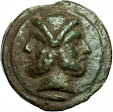
Anonymous Quinarius, Cr 47/1. uncertain mint


Roman Republican Anonymous. AR Quinarius. 
after 211 BC. 
Obv. Head of Roma right, V behind. 
Rev. The Dioscuri galloping right; in exergue, ROMA in linear frame. 
Cr 47/1. 
BMCRR Rome 195
Sydenham 192
RBW 183 - 184
on line British Museum 47.1.1-4 
http://www.britishmuseum.org/research/publications/online_research_catalogues/rrc/roman_republican_coins.aspx
AR. g. 2.12 mm. 16.00 Struck with rusty dies. EF.

Country Roman
Type or era Roman Republican
Coin type Quinarius
Mint   Unknown (Crawford) Rome (Grueber)
Issued by Anon
Issued by Anon
Title of issuer moneyer
Mint Date -211
Weight 2.12
Diameter - max 16
Metal AR
Serrated N
Cr  47/1
BMCRR 195
CRR 192 or 141
Orientation 7
Purchase date http://pics.ebaystatic.com/aw/pics/s.gif
9/12/2015
Grade EF
Centering obv well centered, rev 13% off center. Only half of one Dioscuri star is off coin. 
Strike good strike, reverse looks good, obverse looks lightly struck, but Gruber notes these coins are in low relief
Flan flaws die rust, flow lines
Style excellent gryphon, Roma and Dioscuri typical
Patination light
Damage none
Obverse Roma
Reverse Dioscuri
Obverse Roma wearing winged helmet ornameted with gryphon's head, the visor in 3 pieces, straight lines with slight bend at end, single drop ear ring, double necklace; behind V, border dots
Reverse Dioscuri on horseback holding lances with stars above heads, In Ex - ROMA on tablet
Obverse dies 20
Reverse dies 25

Tuesday, October 13, 2015

A cast coin from Umbria, Tuder - TV-167

A cast Sextans from Umbria, Tuder - Cicada / Trident
TV-167; 220 - 200 BC
11.45 grams / 21 mm
Cast coins circulated in Central Italy until Rome's second Carthaginian war. By that time, bronze was scarce and the weight of the base unit, the As, had dropped from 300 grams to 50 grams or less. Bronze fractions of the As dropped in weight also. Tuder was an independent city and issued coins with a weight standard similar to Rome's. This coin was issued late in the cycle.
This coin is not recorded in Roman Republican books Crawford or Sear. It is listed in books on cast coins by Vecchi, Thurlow & Vecchi, Sydenham, Haberline and Garrucci. It is in HN Italy also. I have digital copies of Haberline & Garrucci. See a previous post for a place to download the books. Haberline had 8 pictures of this coin type and reported weights for 124 coins in his book. The average weight of the heaviest 26 coins was 50 grams. The lightest 98 coins averaged 18 grams. Only two were lighter than my coin. When I looked on line today, 3 of 7 coins I found were lighter than mine.

Country Umbria      
Type or era Cent Italy Cast      
Coin type AES Grave Uncia      
Mint   Tuder      
Issued by Anon TV 167      
Issued by anonymous      
Title of issuer        
Mint Date, BC -220  -220 to -200    
Weight, grams 11.45      
Weight - max 17.95 50.18    
Weight - min 10.40 32.5    
Weight - avg 13.900 42.64 equal to As of 83.4 / 242.8  
Weight - st dev 98.000 26    
Number        
         
Diameter - max 20.9      
Diameter - min 20.8      
Diameter - max         
Diameter - min        
Diameter - avg        
Diameter - st dev        
         
         
Metal AE      
Serrated N      
Cr TV 167 TV 161 is the same but larger and older    
BMCRR V 226 V 220 is the same but larger and older    
Sear: #, VF, EF        
RSC: #, VF, EF        
CRR / AG AG 225 AG 38 is the same but larger and older    
CRI HNI 49 HNI 44 is the same but larger and older    
NMWar Hab Pl 81, 23-26      
NMCr Gar Pl LV, 9      
Orientation        
Orientation        
Purchased from http://pics.ebaystatic.com/aw/pics/s.gif,http://pics.ebaystatic.com/aw/pics/s.gif
Baldwins
     
Purchase date
     
Price 
     
Currency  GBP      
Excahange rate 1.518      
Grade        
Grade VF      
Centering well centered      
Strike cast    
Flan flaws small piece missing where broken from mold    
Style typical, crude artwork for small cast coin    
Patination brown      
Damage none    
Obverse Cicada Sydenham says fly in AG.    
Reverse Trident      
Obverse Cicada with two dots, one on either side      
Reverse Trident with two dots to R and Vt to left. Haeberline gives 3 forms to the second letter: t, y, r (approximately)  
Examples Haeberline 98 Haberline had two groups.     
The earlier group was larger and older. Mine was small and later.        

Sunday, October 11, 2015

My best provenance


I found a few treasures at a local coin show yesterday. I liked this one as a coin, but also because of its provenance - Ex John Quincy Adams collection! I paid a bit more than the $37.50 price on the tag to the right. 
I googled the sale of Adam's collection by Stacks and found an auction catalog. Now I have to decide If I am willing to pay another $80 for that catalog.

Tuesday, June 16, 2015

References for Roman Republican coins

I bought my first Roman coin in the 8th grade. It was a Gallienus with a stag reverse, see below. I bought my second ancient coin after my children graduated from college, about 31 years later. It took some time to decide a collecting area. I became a Friend of the Rice library. They have an excellent selection of ancient coin books. I remember working hard to get the right RIC # for several 3rd century coins. When I decided to concentrate on RR coins, I started buying books. For the first couple of years, I spent about as much on books as I did on coins. I have the following list and a few more. My thoughts on references for collectors of Roman Republican coins and pre-coin money are:

·         Roman Republican Coinage, Michael Crawford, 1974, two volumes. This is the standard reference and by far the best book on the subject.
o   Crawford has several other books that should be added later.
·         Coins of the Roman Republic in the British Museum, H. A. Grueber, 1910 (reprinted in 1970), three volumes. Lots of interesting facts / stories to go with descriptions of the coins. I use Grueber for history and stories to supplement the information in Crawford. A good companion for this book is the British Museum web site listing of their coins. http://www.britishmuseum.org/research/publications/online_research_catalogues/rrc/roman_republican_coins.aspx
·         The History and Coinage of the Roman Imperators 49 – 27 BC, David R Sear, 1998. The go to book for the Imperatorial period.
·         Italian Cast Coinage, Bradbury Thurlow and Italo Vecchi, 1979. The go to book for cast Roman Republican / Italian coins.
o   Italian Cast Coinage, Italo Vecchi, 2013. Revised with some new information and better pictures.
·         Roman Coins and their Values (Republic and 12 Caesars), David R Sear, 2000 (older versions can be found for lower prices). One of the Sear books is a good starting place for a new collector.
·         Roman Silver Coins, Volume I, Republic to Augustus, H A Seaby, 1967. Later publications are by David R Sear. I have an older version because it was $10.
·         The Coinage of the Roman Republic, Edward A Sydenham, 1952 (reprinted in 1975 & 1995). Sydenham numbers are still found in many auctions.
o   Aes Grave, Edward A Sydenham, 1926. An excellent reference, but not available and a bit pricey.
o   Collection of E A Sydenham, Aes Grave … This 1974 reprint of a 1928 auction catalog written in French has some excellent pictures. I am reminded that being mono-lingual is a problem when collecting coins produced in Europe.
·         Coins of the Roman Republic in the National Museum of Warsaw, Janina Wiercinska, 1996. I used this book a lot when I started collecting. It lists many of the common RR coins and has good pictures. It was helpful before pictures became more available on the internet. If I ran across a coin that did not have an attribution, I would start with this book.
·         http://www.acsearch.info/ This web site lists coins sold by over 100 companies. The pictures are exceptional. A good fraction of the coins are high end and the prices are thus skewed. You need to have a good guess to start searching, or finding something in 2.5 million files can be overwhelming.
·         http://www.cngcoins.com/Coins_sold.aspx CNG has sold ancient coins for many years and has a good archive. I have trouble at times making their search engine work.
·         http://www.deamoneta.com/history_search/index This is a smaller auction site, but has excellent archives. Cost to subscribe is modest.
·         http://stevebrinkman.ancients.info/anonymous/#H75-1c This web site shows how to differentiate anonymous denarius by Crawford number.
·         http://stevebrinkman.ancients.info/anonymous/AnonymousVictoriatii.html  This web site shows how to differentiate anonymous Victoraiti by Crawford number.
·         Essays in Honour of Roberto Russo, Ed. By P G van Alfen & R B Witschonke, 2013. Chapter IX by Andrew McCabe gives a provisional arrangement of struck anonymous bronze coins.
·         Aes Grave, E J Haeberlin, 1910, two volumes. An excellent resource, but is expensive and not very available. Reprints can be found at http://www.fornieditore.com The book can be downloaded online at http://gallica.bnf.fr/Search?ArianeWireIndex=index&p=1&lang=FR&q=Haeberlin
·         Le Monete dell’Italia antica, Raffaele Garrucci, 1885. Garrucci. I looked for this book because several pre-coin pieces (cast bars, aes rude, etc.) were described using plates from this book. The book is old, large and not very available. But… it can be downloaded online https://archive.org/details/lemonetedellital00garr
·         An excellent web site on Roman Republican Coins and Books by Andrew McCabe  http://andrewmccabe.ancients.info/ Be careful, I think this web site is the entry point for a black hole. I enter the site looking for a single piece of information and hours later I emerge better informed, but also dazed and confused. 

My Gallienus coin was similar to one listed by Forum Ancient Coins:

A couple of recent additions thanks to NAC. I will add more information as time allows.
 Denarius, Cr 89/2

Quinarius, Cr85/1a

Thursday, May 28, 2015

A Few Cast Bronze Pieces


Anonymous Cast Sextans, Tortoise
Rome, 230 BC, TV-35, Cr 24/7


Anonymous Cast Semis, Post Semilibral
Rome, 215 – 212 BC, Cr 41/6, TV 71

This coin is only 20 grams, lower than the lowest specimen sited in T&V (22 gr). 

Aes Formatum - Cockle-shell
Central Italy, 5th-3rd century BC
 

Cast AE Uncia, Astragalus Club
Rome, with mintmark, Cr 27/10 260 BC
  

Anonymous, Cast Sextans
Shell and Caduceus
Rome, 280-276 BC; Cr 14/5; TV 5

I obtained these recently. The cast shell is similar to the one shown on the coin, but is "dated" earlier. The cast shell may have been used in trade, or cast as an artistic piece.  


I bought this lot of  aes signatum before the two pieces above. One of the pieces is a fraction of  a cast shell / caduceus, TV5, coin.

Roman Republic Cast Triens, "heavy" Janus-Mercury series, 289 - 245 BC, Thunderbolt; on either side two pellets. Rev. Dolphin swimming r.; below, four pellets. Cr 14/3, H pl. 39, 10. Syd. 38. TV 3.

I have a few more to post when time allows. I have moved my Roman Republican collection from mostly silver denarii to some struck bronze and older pieces like aes rude, aes formatum and aes grave. I have avoided the Imperatorial period due to the higher cost.

Saturday, March 7, 2015

Italian Coin Import Restrictions - Request For Your Help

I received two e-mail requests this week asking for input on import restrictions on ancient coins entering the US from Italy. All US ancient collectors should consider the following request from Ed Waddell -

Italian Coin Import Restrictions - Request For Your Help


Dear Client,

The M.O.U. (Memorandum of Understanding) between the United States and Italy that restricts the import of certain Italian coins without provenance is now up for its five year review and renewal at the U.S. State Department.  If you wish to register a comment to the appropriate committee in order to protect your rights as an American Collector, you may do so through the link below.   The deadline for the submission of all comments is MARCH 20, 2015 at 11:59 PM.

If the M.O.U. is extended, Americans will still be able to actively pursue collecting Roman coins, but the number of coins available for import will continue to be limited to those with sufficient pedigrees.  This limitation tends to add costs and precludes certain coins from reaching American collectors that can be freely collected elsewhere.   

Currently in place since January 2011 are restrictions regarding the import of Greek coins struck in Italy, Punic coins, Etruscan coins, and Republican coins struck prior to 211 B.C.  This M.O.U. also covers Italian artifacts.  There is however reason to believe that the current renewal will also seek to restrict late Republican and Roman Imperial coins.  The current restrictions have already made it difficult to import such coins legally, and many cannot be imported at all due to lack of paperwork.  New restrictions on late Republican and Roman Imperial coins would raise the same issues.  This would be an unwelcome and unjustified extension of the regulations, particularly due to the fact that so many Roman coins of this later period traveled widely in antiquity. Therefore, Italy has no legitimate claim for their repatriation.  In fact, an academic study submitted to the 2010 committee considering the current Italian M.O.U. lists 39 modern countries where Roman coins have been found. 

Italian Finds Report 

The other important point to stress is that many Roman coins that have been in collections for decades or even centuries do not have published or preserved pedigrees.  This is due to their low value in the past and the relatively high cost of photographing coins in the older catalogs.  Thus, both the current regulation which is up for review and especially any extension to cover later Republican and Roman Imperial coins is extremely unfair to American coin collectors who are engaged in the study and preservation of the coins.  For more information on the background of this restriction, please see:http://culturalpropertyobserver.blogspot.com/2015/02/enough-already-oppose-yet-another.html by Peter Tompa, a cultural property attorney who is representing the professional coin dealer organizations (IAPN and PNG) in this matter.
If you wish to register a comment prior to the March 20 deadline, you may do so by copying this to your browserhttp://www.regulations.gov#!documentDetail;D=DOS-2015-0010-0001.  Even though we have had limited success in the past with submitting comments, we have  achieved some limitations on import restrictions.  Our silence would be construed as complete acquiescence.  
Please note that your comments will be listed on the public web site of the State Department and there is no expectation of privacy, however you are not required to list your contact information.     

It is best to comment in your own words, but you may freely use or adapt the following: 

"Dear CPAC:

Enough is enough. This MOU should be allowed to lapse. Its negative impacts on collecting and the appreciation of Italian culture and people to people contacts, collecting brings now far outweigh any benefits. At a minimum, please free all ancient coins from restriction. Such coins are openly and legally available for sale worldwide, including within Italy itself. It makes absolutely no sense to continue to restrict American access to what Italians themselves have enjoyed since the Renaissance. Finally, please do not recommend new restrictions on Roman Imperial Coins. As the products of a great empire, these coins circulated throughout Europe, the Middle East and beyond. They "belong" not to Italy, but to us all."

Thank you for your assistance in our attempt to keep open the ability to import all Roman coins.  

Ed Waddell

A link to the ACCG is:
http://culturalpropertyobserver.blogspot.com/2015/02/enough-already-oppose-yet-another.html