Sunday, March 6, 2016

Quintus Caecilius Metellus Pius Scipio Nasica Mint – Africa; 47 to 46 BC Cr. 461/1

Quintus Caecilius Metellus Pius Scipio Nasica
Mint – Africa; 47 to 46 BC

Cr. 461/1


Roman Republican silver denarius, 47 - 46 BC
Military mint traveling with Scipio in Africa
Issued for Quintus Caecilius Metellus Pius Scipio Nasica, Imperator and leader of army of Senate fighting Julius Caesar
Issued by Marcus Eppius, Legatus flandum curavit - or legate of camp treasury which implies the mint was a military one. Sear in CRI notes this is the only coin to use this title.
Obv - Head of Africa right wearing elephant's skin; grain ear before, plow below; to right - Q METELL; to left - [SCIPIO IMP]; the elephant-skin headgear represents Scipio’s African imperium.
Rev - Hercules standing facing; holding right hand on hip and with left hand holding club that is draped with a lion’s skin, [resting on rock], to right – [EPPIVS], to left - LEG F C
3.96 grams; 16.5 / 17.2 mm, slightly oval; off center 0.5 mm or 3% on obv and 2.5 mm or 15% on rev
EF
Well struck from new obverse and older reverse dies.
Obverse art work is good. Reverse die is less so. Hercules looks a bit like Jimmy Durante.
Flan is too small to hold art work. On obverse SCIOIO IMP and top part of elephant are off flan. On reverse EPPIVS, Hercules feet and the rock are off flan.
Crawford – 461/1
Grueber – Africa 10 – 14, 10 & 11 are large head
Sear, RCV – 1380/1 (large head) & 1380/2 (small head)
Sear, Imperators – 44
Sydenham – 1051
RBW - 1605

Quintus Caecilius Metellus Pius Scipio Nasica, was a consul with Pompeius in 52 BC, the year he arranged the marriage of his newly widowed daughter to him. He was a strong supporter of the rights of Patricians (the traditional ruling class) against new men who were Plebians (free men who were not Patricians). His father fought on the winning side of Sula against the Marians. He fought unsuccessfully on the side of Pompey against Julius Caesar.
Patricians were historically afforded more privileges than plebeians. They were better represented in the Roman assemblies. The Comitia Centuriata, the main legislative body, was divided into 193 voting centuriae, or centuries. The first two houses, consisting largely of patricians, together had 98 centuriae, a number which was enough to obtain a majority, despite the fact that they were fewer in number. That meant that if the patricians acted in concord, they could always determine the result of the voting of the people's assembly. So, although it was not forbidden for plebeians to hold magistracies, the patricians dominated the political scene for centuries.

He had consuls all over his family tree:
father - Publius Cornelius Scipio (Cons 80 BC) was the son of P Cornelius Scipio Nasica Serapio (Cons 111BC).
mother - Licinia Crassa daughter of L Licinius Crassus (Cons 95 BC)
adopted son of Q Caecilius Metellus Pius - (Cons 80 BC), Metellus Pius helped Pompey defeat Sertorius who led a rebellion in Spain
wife - Aemilia Lepida, daughter of Mamercus Aemilius Lepidus Livanus (Cons 77 BC). He was engaged to Aemilia, broke the engagement and then decided to marry her after Cato proposed. This made an enemy of Cato, the great orator.
daughter - first married son of consul, and when first husband died, married Pompey (who had previously been married to Julius Caesar's daughter).
Distant relative (by adoption?) of Scipio Africanus – several generations and too confusing for me to understand and relate here.

Ronald Syme called him "the last Scipio of any consequence in Roman history."

Classical scholar John H. Collins said Metellus Scipio was as personally despicable and as politically reactionary as they come. He was honorable only in death. Having lost his armies in two battles in Africa, he fled in a ship, but was driven back upon the African coast by a head-wind and saw his ship in the power of the enemy. He committed suicide by piercing his body with a sword; and when they asked where the commander was, he replied: ' Imperator se bene habet' (or "All is well with the commander.") In death, Metellus Scipio achieved an uncharacteristic dignity, worthy of his great forebears. 

During the civil war between Julius Caesar and the senatorial faction led by Pompeius Magnus ("Pompey the Great"), he remained a staunch optimate (supporter of Patrician rights). He led troops against Caesar's forces, mainly in the battles of Pharsalus and Thapsus, where he was defeated.


Thursday, December 3, 2015

AES “Money” from Republican Rome and Central Italy

AES “Money” from Republican Rome and Central Italy
EEM 12/2/15
The story of the founding of Rome; April 21, 753 BC; is based on several oral traditions that were put in writing centuries later. Roman scholar Marcus Terentius Varro chose the date in the first century B.C.
Historians say that a wave of immigrants entered Italy from Asia about 2000 BC and again about 1000 BC. The second wave probably settled around Rome. Archeological records say that central Italy around Rome was populated from the 1000 BC.

The early Romans were primarily subsistence farmers. They did not have significant wealth in the form of gold or silver and made transactions by barter. Early fines were recorded in cows and sheep. In the fifth century, fines were converted to bronze asses.  
1 Cow = 100 Asses
1 Sheep = 10 Asses
1 As = 1 Roman pound of bronze, or
1 As = 330 grams = 11.6 ounces

Coins were invented in the 7th century BC by the Kingdom of Lydia (now western Turkey). They quickly spread to the independent city states of Ionia and Greece (the Aegina turtle, the Athens owl, and others). Coins were used to facilitate trade. It also made it easier to pay mercenary armies. See four examples from Lydia, Ionia, Persia and Athens.

Roman armies were drawn by family or clan. Only men who could afford to buy arms and armor were drafted and allowed to fight. The richest could afford horses and became the cavalry. When an army was needed soldiers left their farms, fought for a short time and returned to their farms. Rome did not pay its armies until 405 BC during the ten year long siege on Vei. In 405BC Rome did not mint coins and would have used barter (bronze by weight) or coins from Greece or Greek colonies in Italy.

AES Rude are irregular shapes of bronze that were traded by weight. In Latin, AES Rude = Rough Bronze. Some of the AES Rude are pieces broken from cast plates or bars. Other pieces look like they were formed individually and have irregular surfaces.

My wife asked how I know they are not just rocks. I said, "faith in the supplier, looks and weight/SpGr.... and there is no way to know for sure."


AES Formatum are bars with no features. They are normally identified in ratios of Roman pounds, or equivalent Asses.
 
Aes formatum, VIII-IV cent BC, Artemide Aste, 2.5 asses
This lot has a piece of AES Formatum in the upper right corner. The others are pieces of AES Signatum and AES Grave, see below.

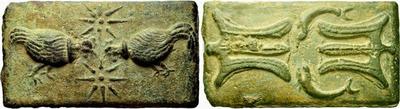
AES Signatum are bars with features. Whole bars with features are rare and expensive. A few examples are:

2 chickens / 2 tridents; Crawford 12/1; 270 BC
Sold by NAC in 2009 for $125M


Fragment of "ramo secco" bar, 3rd cent BC
 Sold by NAC in 2003 for $4M

Bull / Bull; Crawford 5/1; 270 BC
Andrew McCabe Collection

Pieces of Ramo Seco bars


AES Grave are cast bronze coins. They were based on an As of one Roman pound of bronze. There were multiples and fractions:
X = Decussis = 10 Asses
V = Quincussis = 5 Asses
III = Tressis = 3 Asses
II = Dupindius = 2 Asses
I = As = 12 unciae = 300 oz. bronze
S = Semis = 6 unciae
4 dots = Triens = 4 unciae
3 dots = Quadrans = 3 unciae
2 dots = Sextans = 2 unciae
1 dot = Uncia
Sigma = Semiuncia, or less than uncia

 
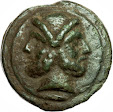
Roman Republican. Libral standard. Janus/Prow As, 225-217 B.C.
Obv.: Head of Janus. Rev.: Prow right.
Crawford 35/1. TV 51.
AE (bronze); 258 gr; 63mm; gVF
Artemide Aste


Roman Republican. Post Semi Libral standard. Janus/Prow As, 215-212 B.C.
Obv.: Head of Janus. Rev.: Prow right.
Crawford 41/5a. TV .
AE (bronze); 71 gr; 39mm; XF
Artemide Aste


The small coins at the top left of the display are a few Greek coins that predate Roman coinage.
From left to right is a chronological display of AES or bronze “money” from Rome and Central Italy.
The Aes Rude shown here are from central Italy. Some could be Roman at the time they were produced, but more likely were areas outside of the original seven hills that made up the city of Rome. All of these areas eventually became part of Rome. Some of the Aes Rude are broken pieces of bronze. Larger broken pieces are grouped in the AES formatum and signatum section in the middle surrounding a 746 gram cast bar = 2.5 Asses. Two small pieces of Ramo Secco bar are to the right of the largest bar. Cast coins are, from left to right, oldest to newest, and from top to bottom: As, Semis, Triens, Quadrans, Sextans, Uncia and semi-uncia. The set are Crawford 35's, 225 to 217 BC. You can see the weight reduction due to a shortage of bronze in the second Punic war in the As and Semis on the top right.

Tuesday, November 17, 2015

Q. Titius As 90 BC


I picked up an interesting coin recently - Q. Titius Æ As, Cr. 341/4d, 90 BC
Q. Titius AE As, Rome, 90 BC.
Obv - Laureate head of Janus
Rev - Prow of galley right; Q TITI above, control symbol to right.
Crawford 341/4d;
Grueber Rome 2236
Sydenham 694b.
Sear 743
RBW 1279
9.26g, 26mm, 9h.


This one has a control mark in front of the prow that I could not identify, but was advised it is a helmet. That looks correct to me, but it is not on the list. Crawford (and Grueber, Sear and others) list the following control marks:
caps of the Dioscuri
Crescent
Caduceus
palm branch
Star
Ass's head
Cornucopiae
Horse's head
dolphin
A summary of examples I found on the internet:


Loc
Num
Where found
Star
3
15
1, 2, 4, 8, 9, 14
Palm branch
3
3

Crescent
1, 3
4
6, 10, 11, 3
Caps of Dioscuri
1
1
1
Helmet
3
1
15
Cornucopiae
3
1
3
Caduceus
2


Ass’s head
3


Horses’s head
3


Dolphin
4


?

1

Total found

29


Location of mark
  1. Above
  2. Behind
  3. Before
  4. Below

Examples found in:
  1. CNG
  2. NAC
  3. British Museum
  4. Kunker
  5. Artemide Aste
  6. Heritage
  7. HD Rauch
  8. Naville
  9. Monaise d’ Antan
  10. Tkalec
  11. Triskles
  12. Old Roman Coins
  13. Ancient Roman Coins
  14. GHN
  15. Roma Num
  16. London Ancient Coins


Total found – 29

NAC73 L99 - Star

CNG88 L1150 - Palm Branch

Tkalec Feb 2008 L382 - Crescent above

Trisk Oct 2013 L86 - Crescent before

CNG79 L888 - Caps of Dioscuri

BM341.4.6 - Cornucopia

Roma E21 L  - helmet


Tuesday, October 20, 2015

L.CENSOR, Roman Republican AR denarius, Rome, 82 BC

L.CENSOR, Roman Republican AR denarius, Rome, 82 BC 


Roman Republican AR denarius, Rome, 82 BC
L.CENSOR - Lusius Marcius Censorinus 
Obv - Laureate head of Apollo right 
Rev - Marsyas walking left, shouldering wine-skin, right arm raised (in a token of freedom), naked except for buckskins, tall column bearing statue (of Minerva, draped figure, Victory or ?) behind. Before L.CENSOR
The seller's attribution -RCV 281; NGC AU 5/5 - 3/5.
My attribution - Cr 363/1d (no control marks);
BMCRR - Rome 2657 - 2659; Syd - 737; Marcia 24; RBW 1372
VF/gVF with environmental damage to obverse, well centered and well struck
I picked this coin because the reverse is well struck and centered. I can almost see the statue on the column that is given several different names. 

I like the story of Marsyas and how it relates to the moneyer Censorinus. In Greek mythology Marsyas was a satyr who challenged Apollo to a music contest. The winner could do as he pleased to the loser. Marsyas lost and Apollo tied him to a tree and killed him. (Those of you who want a more graphic account can google Marsyas.) The Romans considered Marsyas the inventer of augery (interpreting omens), a proponent of free speech and was considered one of the gods who looked after the Plebs (common people). The first Plebe elected as Censor erected a statue of Marsyas in the Forum. This coin shows the statue. L Censorinus issued the coin at the time Sula "recaptured" Rome for the Patricians (aristocrats or old families) from Marius (hero of the new families). Censorinus was killed in the proscriptions that followed.

The Marcia gens (clan) claimed descent from Ancus Marcius, 4th king of Rome and the first to bring water to Rome by aqueduct.

Sunday, October 18, 2015

C.EGNAATIVS.CN.G.C.NN.MAXSVMVS Cr-391/2 75BC

C.EGNATIVS.CN.F.CNN. MAXSVMVS.
Cr-391/2; 76 BC


Roman Republican AR denarius, 76 BC
C. Egnatius Cn.f. Cn.n. Maximus
Obv - bare-headed and winged bust of cupid; bow and quiver of arrows over shoulder; behind – MAXSVMVS (archaic for MAXIMVS)
Rev - Jupiter with staff and Libertas with outstreached hands in distyle temple; above Jupiter thunderbolt; above Libertas - pileus; in ex and around - C.EGNATIVS.CN.F.C.NN
19.7 mm, 3.90 g, 6 h
Crawford 391/2
Sydenham 788
RSC / Bab Egnatia 3
aVF, off center.

The Egnatio gens was of Samnite origin and moved to Rome after the Social War.
Cicero mentions a Cn. Engatius of somewhat disreputable character who was admitted to the Senate and was subsequently expelled.
Country Roman
Type or era Roman Republican
Coin type Denarius
Mint   Rome
Issued by C.EGANTIVS
Issued by C.EGANTIVS.CN.F.C.NN.MAXSVMVS
Title of issuer moneyer
Mint Date -75
Weight 3.90
Diameter - max 19.8
Diameter - min http://pics.ebaystatic.com/aw/pics/s.gif,http://pics.ebaystatic.com/aw/pics/s.gif
18.5
Metal AR
Serrated N
Cr  391/2
BMCRR 3276 - 3284
Sear: #, VF, EF 325
Bab Egnatia 3
CRR 788
Orientation 7
Purchase date http://pics.ebaystatic.com/aw/pics/s.gif
1/17/2015
Grade aVF
Grade aVF
Centering obv is 26% off center and part of Cupid's face is off flan, reverse is about 10% off flan. All features but control number are on reverse. 
Strike strike is good where on flan
Flan flaws none
Style good style
Patination light
Damage none
Obverse Cupid
Reverse Jupiter & Libertas
Obverse Cupid with bow and quiver over shoulder; behind - MAXSVMVS
Reverse Jupiter with staff and Libertas with outstreached hands in distyle temple; above Jupiter thunderbolt; above Libertas - pileus; in ex and around - C.EGNATIVS.CN.F.C.NN
Obverse dies 20
Reverse dies 25
Notes:   1 The Egnatio gens was of Samnite origin and moved to Rome after the Social War. 
2 Cicero mentions a Cn. Engatius of somewhat disreputable character who was admitted to the Senate and was subsequently expelled.