Thursday, June 4, 2020

Countermarked Aes Formatum, Dupondius - something not seen often

Countermarked Aes Formatum, Dupondius

Latium, 3rd century BC


I recently added an interesting piece of cast bronze to my collection of Roman Republican coins, cast bronze money from Central Italy and Roman scale weights. The marks of value, if that is what they are, are the same as a 2 As Roman scale weight found in excavations of Pompeii - II. The weight, 559 grams = 280 gr equivalent As, is close to two Roman pounds, 654 grams. Only a few of the early cast Asses weigh over 280 grams. A description of the piece and how it fits my collection is below.


Roman Republic / Central Italy – Cast Bronze with Marks
Cast bronze was a form of money before Rome and Central Italy issued coins. This triangular piece looks like it was broken from a pie shaped circular ingot. Two marks “II” on this piece could indicate it had a value of two Asses, or one Dupondius. Some Roman two As (pound or Libra) scale weights use a similar symbol – II. Two As weights in the British Museum and from Munich are pictured below. Similar shaped bronze pieces are shown in Garrucci, Table III. His description is below. Several books show inscriptions on cast bronze. Some bronze pieces with inscriptions from my collection are shown below.

The vendor’s description:
Aes Premonetale. Countermarked Aes Formatum (Dupondius), Latium, 3rd century BC.
About one-sixth of a circular cake-shaped bronze ingot, countermarked II (mark of value) on the flat base. Vecchi ICC- (cf. p. 25,2: Counterstamped and inscribed aes rude, Central Italy, 7th to 3rd centuries). Of the greatest historical interest and apparently unpublished. Lovely untouched earthen olive green patina, with lighter spots.

559.0 grams
67x65x31 mm.
Good VF, RRRR

Similar pieces are in some of the Roman / Italian cast bronze books:
       1.  ICC, Thurlow & Vecchi; plate 2 shows one piece of Aes Rude with a crescent mark.
·        2.   ICC, Vecchi; On pg. 25 is a paragraph on Counterstamped and Inscribed Aes Rude, central Italy 7th to 3rd centuries. Plate 1 shows + and crescent counterstamps.
·        3.  Inscribed aes rude or bars are not mentioned by Grueber, Sydenham, Crawford or Sear.
·        4.  Garrucci has pages of sketches of aes rude and aes signatum. Item #1 on plate LXVII has a crescent and + and weighs 30 grams. Table III has similar shaped pieces. Translated from pg 3:
o   Assembled are five pieces from the Cere deposit, because they show the round metallic loaves divided into four parts. The five pieces weigh:
§  Two pounds and two ounces, 709 grams
§  Two pounds eight ounces, 872 grams
§  Four pounds and eight and a half ounces, 1540 grams
§  Four pounds and three ounces, 1390 grams
§  Four pounds and eight and a half ounces, 1540 grams
·        5.  Haeberlin has pages of pictures of aes rude and aes signatum. Some have letters.
o   T3, #9 – irregular shape with mark: “N”; weight 567.5 gr
o   T4, #5 – irregular piece of plate with mark: “L” using archaic L, & dot on top; weight 511.92 gr
o   T4, irregular shapes with marks:
§  #6, mark: + and weight: 50.25 gr
§  #7, mark: + and Crescent 30.04 gr
§  #8, mark: + and Crescent 39.50 gr


Aes Rude / bars with marks clockwise: crescent & + (centering mark), + (no centering mark), II


Aes Rude with crescent and +, note the centering dot


Picture on left shows an Aes Rude, 30 grams, with crescent and + (note the centering dot) from Garrucci Table LXVII. The two aes rude pieces are shown above.  


Aes Signatum fragment with incuse symbol, C or crescent moon; 
22.39 grams; 25.29 X 23.36 X 6.5 mm


Size of three one As weights compared to 2 As Aes Rude


Picture of 1st century Roman scale weights from British Museum.


Two LIBRAS, Roman pound, weight from the Bavarian Archaeological Collection (Munich).

rrdenarius Cast Bronze Collection, 6/1/2020

Weight, gr
Description
2,532.7
large bar
1,441.9
quarter of round cake
891.4
RS bar Art Ast
853.6
RS bar Germany
254.5
RS bar piece
128.2
RS bar piece
53.9
RS (?) bar piece
743.4
Cast bar
388.2
Aes plate piece
374.6
Aes plate piece
596.9
Bar with + and crescent
557.6
Bar with II
48.4
Aes rude with +
37.7
Bar with lines
220.0
Bar piece
104.8
Plate with decorations
905.0
box 1
1,014.0
box 2
313.4
aes rude, flat on 1 side 
11,460.2
Total grams
35.0
Equivalent asses
11.7
days pay at 3 asses per day

Wednesday, May 27, 2020

Prow Left Aes Grave Sextans, Cr 36/5

Prow Left Cast Sextans
Cr 36/5, 225 – 217 BC
I bought a prow left Sextans in the NAC auction last weekend. It is the 3rd prow left coin I have bought in less than a year, and the most expensive. I live in the US. The coin is across the Atlantic Ocean. I am sure it will take a while to get here, so I am using NAC's pictures.
The largest issue of cast bronze coins by Republican Rome had the prow (business end) of a warship on the reverse. Most were prow right. I do not know why some prows were pointed left, but there were enough prow left coins that Haeberline put then into 3 groups. Crawford followed suite and had three groups also:

  • First Prow Left cast coins, 225 - 217 BC, wt std As = 270 grams - Cr 36: 1 - As; 2 - Semis; 3 - Triens; 4 - Quadrans; 5 - Sextans
  • Second Prow Left cast coins, 217 - 215 BC wt std As = 132 grams - Cr 38: 1 - As; 2 - Semis; 3 - Triens; 4 - Quadrans; there were struck Sextans, Uncia, Semuncia and Quartuncia coins in this group. 
  • Third Prow Left cast coins, 215 - 212 BC wt std As = between 132 and 54 grams - Cr 41: 1 - Decussis; 2 - Quincussis; 3 - Tressis; 4 - Dupondius; 5 - As; 6 - Semis; 7 - Triens; 8 - Quadrans; there were struck Semis, Triens, Quadrans, Sextans, Uncia and Semuncia coins in this group. 
I find it interesting that Crawford put three series of coins in a short time window of 225 to 212 BC. The weight ranges for the coins overlap. All of the cast Sextans were in the first group.


Roman Republic Cast Sextans circa 225-217, Æ
Obv - Head of Mercury l.; below, two pellets.
Rev - Prow l.; below, two pellets.
46.23 grams = 277 gram equivalent Ass
24 mm – this looks wrong, most on line are 30+
12 h – most of the cast coins I have seen are medal turn, or the obverse and reverse have the same orientation. A few are orientated coin turn, 6h. Even less have 3h or other orientations.
Brown green patina and very fine
Very rare (seller's words) – I found 10 examples on line, including mine.

Crawford 36/5, wt std = 270 grams
Aes Grave 23
Sydenham 82
Vecchi 92
Thurlow-Vecchi 62, wt std = 256 grams
RBW –.
Historia Numorum Italy 341.
Haeberlin p 55 – 56, plate 22, 17 – 20; wt range 34 – 54 grams

Sunday, May 10, 2020

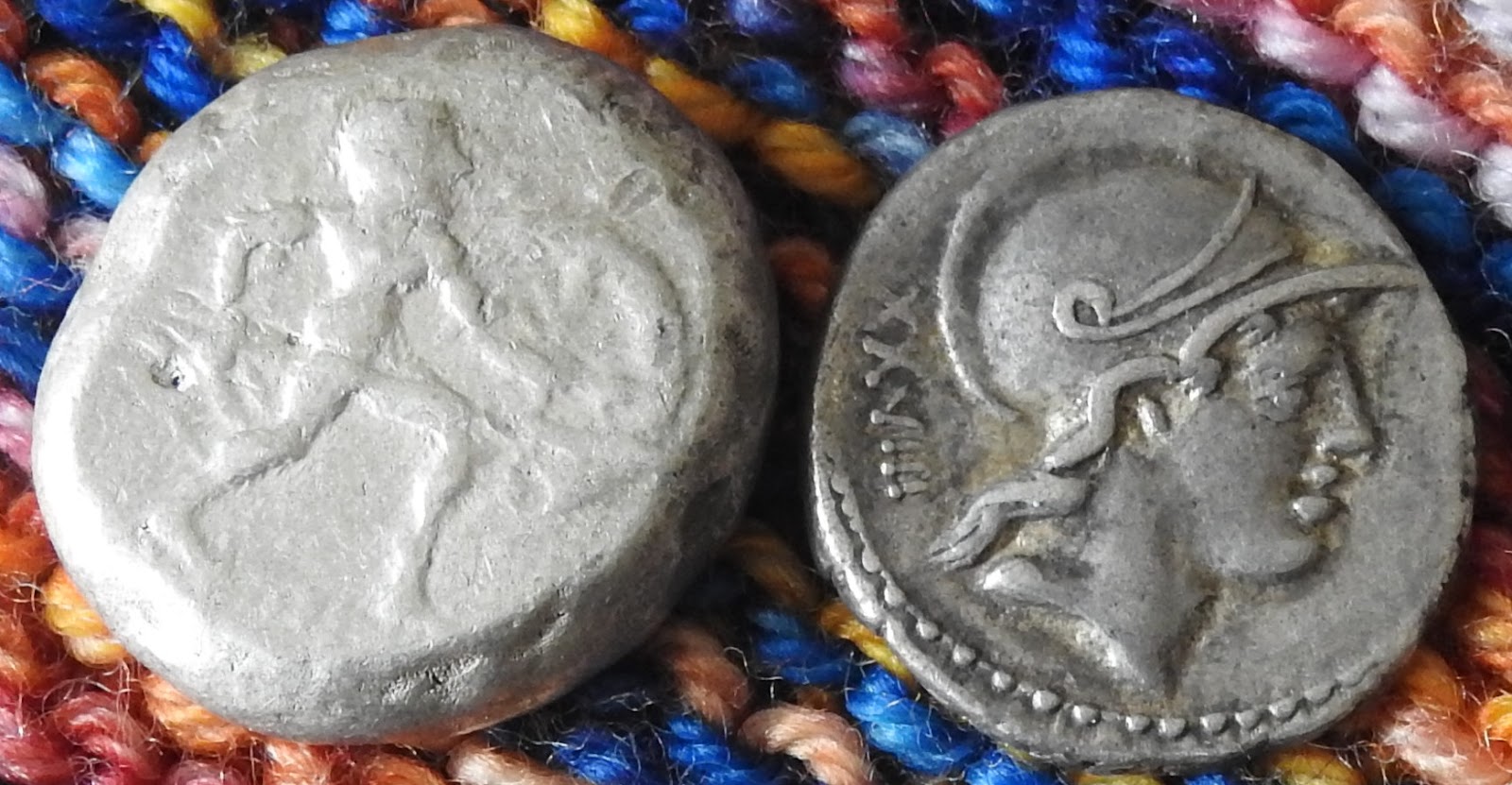
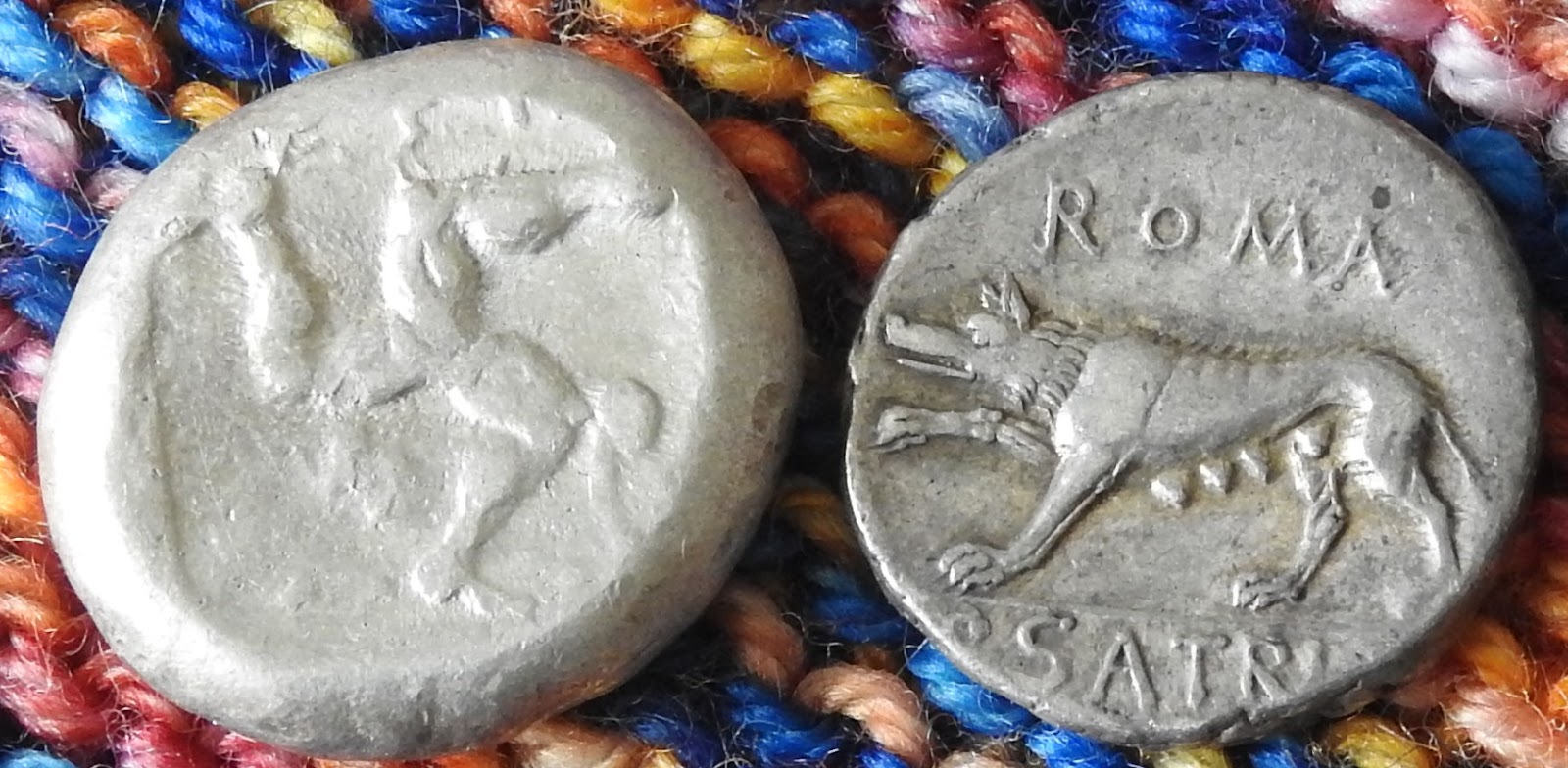
One Hoard and Two Coin Types – Owl of Athens & Triskeles from Pamphylia Aspendos


Recently I bought two interesting coins:
 Athens / Owl Tetradrachm from Athens – this is one of the best known ancient coins. 
 Hoplite / Triskeles Stater from Pamphylia Aspendos. These coins were rare until the last few years.  


Attica, Athens AR Tetradrachm. Circa 454-404 BC.
Head of Athena right, wearing earring, necklace, and crested Attic helmet decorated with three olive leaves over visor and a spiral palmette on the bowl
Owl standing right, head facing; olive sprig and berry in upper left field, AΘE to right; all within incuse square.
Struck on a flan that includes all of Athena’s helmet crest and full reverse borders.
17.17 grams

1 h


·        I thought the Crack-em-Out shirt by TIF was a good back ground for my slabbed owl. 


·        
Pamphylia, Aspendos, 465 - 430 BC, Silver Stater
Obverse: Hoplite warrior advancing right holding spear and round shield. The end of the spear behind the soldier has some extra lines, like a trident pointing the wrong way. I do not see them on other examples. The lines could be an insect with 6 legs or flow lines on the die.
Reverse: Triskeles, 3 legs running, below - lion crouching left in background, above - EΣT, all within incuse square.
10.73 grams
19.4 X 17.3 X 4.8 mm
Sear – 5381 - 5383 are similar, 5383 is the best but not exact match, 460 – 420 BC
HISTORIA NVMORVM, Barclay Head – Pg 699, Fig 317, 500 – 400 BC
BMC – 19.93, 1-2 or 19.94, 9
SNG von Aulock 4482-3
Notes:
·         Part of the recent hoard of Athenian tetradrachms which included these staters as well as a fewer from Cilicia.
·         The coin was sold as rare, but I found 750 similar coins on acsearch (PAMPHYLIA Shield Triskeles). Something like a hoard significantly changed availability. VCoins has 64 and MA Shops has 15 similar coins for sale.
·         Behind the Triskeles on the reverse are: nothing, lion crouching left, lion standing left, lion jumping right, ivy leaf / vine or eagle.
·         Reverse inscription on my coin is EΣT.
o   Some coins replace the T with a turtle.
o   Head reported these inscreptions: E, EΣ, EΣT, EΣTFE, EΣP, and others
o   The legend represents the Pamphylian form of the name of Aspendos – EΣTVEDIYS
·         A hoplite was the most common type of heavily armed foot-soldier in ancient Greece from the 7th to 4th centuries BC. The principal weapons of a Hoplite infantryman were a long ash wood spear, a short sword and a large circular shield. (ancient.eu/hoplite - Mark Cartwright)   
·         Aspendos or Aspendus (Pamphylian: ΕΣΤϜΕΔΥΣ; Attic: Ἄσπενδος) was an ancient Greco-Roman city in Antalya province of Turkey, located about 40 km east of the modern city of Antalya, Turkey. It was situated on the Eurymedon River about 16 km inland from the Mediterranean Sea.
·         Hoplite / Triskle coins have been featured on several Coin Talk posts in the last few years. More information here: http://augustuscoins.com/ed/interesting/triskeles.html


 For comparison the owl, stater and a Roman denarii are shown together.

Sunday, April 19, 2020

More Cut Coins and a Large Struck As

I picked up two lots in an auction last month. They made it from San Marino to Texas in a day or two less than a month. The lots add a few cut coins to my pile of hands on pieces. I also added the second heaviest struck coin in my collection. I attributed most of the first lot.

 RR Lot Struck Bronze and Silver Plated Coins


Roman Republican coin lot.

Using seller’s pic, on red background, from top left to bottom left clockwise:
1.      RR Quadrans: Anonymous, Rome, 91 BC
a.       Obv – Herculese right
b.      Rev – Prow right
c.       3.72 grams, 18.46 X 16.95 X 2.5 mm
2.      RR Triens:
a.       Obv – Minerva right
b.      Rev - Prow right, above ROMA
c.       12.58 grams, 23.5 X 23.0 X 3.7, note the coin is cupped
3.      Unknown: I bought the lot hoping that coin #3 was a cast uncia. The coin picture looks a lot like a cast uncia, but the dot in the center is an innie (see below). I think it is a late Republican / Imperatorial bronze coin.
a.       23.92, 33.1 X 29.4 X 4.5
4.      RR Plated Quinarius: Most of the plating on this coin is missing. It is difficult to attribute the coin from what is left. My best buess is that it is the large issue of Cn. Cornelius Lentulus Clodianus in 88 BC, Rome mint, Cr 435/2. 
a.       Obv – head of Jupiter R
b.      Rev – Victory crowning trophy? Most of the reverse is missing. There may be letters in ex.
c.       1.65 grams, 15.35 X 14.27
5.      RR Plated Denarius: D.SILANVS.L.F; Rome; 91 BC
a.       Obv – helmeted head of Roma, R; behind control mark, T; border dots
b.      Rev – Victory in biga, R; above control mark ?; in ex – D.SILANVS.L.F / ROMA
c.       3.02 grams, 20.79 X 18.35
6.      RR Anonymous As: Rome, 200 BC +/- 20 years
a.       Obv – Janus head, mark of value above
b.      Rev – Prow R; above mark of value, I; hard to tell if there are any letters before the prow; in ex, ROMA.
c.       45.18 grams, 33.88 X 32.68 X 6.9; this is the second heaviest As in my collection!


I bought the lot hoping that coin #3 was a cast uncia. The chances were low, but the coin picture looks a lot like a cast uncia I bought recently. The left coin below is a knuckle bone / dot Aes Grave Uncia.


The struck As, #6, is the second largest I have at 45 grams. One of the first struck Asses I bought was 48 grams. I did not know how long it would be before I bought one about the same size! This one is thick. It is worn enough that features, especially letters, are hard to see. I can see some bumps where ROMA should be in ex and marks of value, I, above the Janus head and Prow. What I see in front of the prow changes from nuttin to several letters. I will call it anonymous.


The denarius and quinarius are both plated. Enough of the Denarius remains that I feel pretty good about its attribution. I am not sure if the smaller coin is a Victoratii or Quinarius. My guess is a first century issue of Cn. Cornelius Lentulus Clodianus, Cr 435/2.


I briefly looked for examples of the Quadrans and nothing said this is it. It might be a Crawford 339/4 or something close. The weight and size suggest a late 2nd or 1st century BC date. The anonymous elephant Quadrans shown below is dated 128 BC and has a similar weight, 3.24 grams.


 The second lot is mostly cut coins. It is intended for show, tell and handle talks to non collectors. 
 
Struck Bronze and Pb Seals


Wednesday, April 15, 2020

Bull Wheel, Semis Cr24.4 269 to 240 BC


Bull Wheel, Semis
Cr24.4 269 to 240 BC

Seller's Pics


I took pics with several different lights. This one shows the features best, but not the color.


Roma/Wheel series. AE Cast Semis, c. 230 BC.
Obv - Bull leaping left; S below.
Rev - Wheel of six spokes; between two spokes, S.
99.8 grams 1, 50.0 mm, die rotation 00
Grade, rrdenarius - VF; seller - VF, aVF, Rare 2
well centered, nice casting with good features, wheel on reverse is low profile, no flan flaws, typical style; patina 3 - light tan, the patina color & fine surface irregularities make seeing and photographing features hard; no damage;
Cr. 24/4; 265 to 242 BC; Wt Std = 270
BMC Greek Italy; Pg 54, Central Italy #5 & #6
Haeberline; Pg 59 - 60, 70 examples, 104.3 to 171.2 grams; Pl 25, 1-7
HNI, 327
Sear: 535
RBW, 34                                            
Sydenham CRR = 60; Syd AG = 87; Syd collection =
T & V, 32; 269 to 240 BC
Vecchi, ICC, 67
Garrucci, Table XL, #1; Pg 21, Wt = 4 ounce + 18 den = 133.2 grams        
not in BMCRR, Bab / RSC   

Notes:
1     1. Weights from various sources:
a.       _                      On Line                       Haeberline
b.      Number           37                                70
c.       Max Wt, gr      166                              171
d.      Min Wt, gr      92                                105
e.       Avg Wt           128                              133
f.       St Dev             19                                15
2.      2. Vendor called the coin “Rare”. I found 70 examples in Haeberline, 13 examples in the ANS web site CRRO and another 24 from various places in books and on the web. Two CoinTalk members have posted their examples of this coin - Andrew McCabe on Oct 15, 2019; AncientJoe on Sep 6, 2014.
3.      3. Vendor said: “Untouched earthen light green patina.” I do not see green, but that is often the case because I am a bit color blind.


Two early cast semis: Bull / Wheel and Pegasi / Pegasi

Two early and one late Semis.


Plate of Bull / Wheel from Haeberlin.
He illustrates 7 of the 70 examples in his book.