Wednesday, January 23, 2019

Pre-Coin Roman Money my display at The 62nd HOUSTON MONEY SHOW

I have been interested in how Rome paid their soldiers at Veii about a century before they started producing coins. Info from my display on the subject is below.

Pre-Coin Roman Money 

Roman "money" from 1000 to 390 BC, or how did Rome pay their soldiers at Veii in 400 BC if they started producing coins in 300 BC?

GHCC Money Show
January 17 – 19, 2019
rrdenarius.com


Rome paid soldiers for the first time at Veii about 400 BC. Before that extended campaign soldiers paid their expenses. Only moneyed men could fight, and collect glory and spoils. 

Servius Tullius, the 6th king of Rome, reigned from 575 to 535 BC.He divided Roman citizens into Classes by wealth. The top class of citizen was required to have 100,000 asses where one As equaled a Roman pound = 327 grams. This level of wealth put a man in the equites or knights. Something was used for money before coins introduced in 280 BC.


Bronze was used for money. It seems likely that steelyard scales would have been used. They are better for weighing heavy items than the double pan balance.

The following quotes are from Livy - 
[Titus Livius in his History of Rome spoke on this.
Ab
urbe condita 4.59   "... the senate decreed that the soldiery should receive pay from the public treasury. Previously, each man had served at his own expense.“
Ab
urbe condita 4.60   "... The senators were determined to uphold a measure so happily inaugurated, they were themselves the first to contribute, and as coined money was not yet introduced, they carried the copper by weight in wagons to the treasury, thereby drawing public attention to the fact of their contributing. After the senators had contributed most conscientiously the full amount at which they were assessed, the leading plebeians, personal friends of the nobles, began, as had been agreed, to pay in their share. When the crowd saw these men applauded by the senate and looked up to by the men of military age as patriotic citizens, they hastily rejected the proffered protection of the tribunes and vied with one another in their eagerness to contribute." ]

The first two pictures show one week's pay (about 15 US pounds) in bronze bars, cakes and panes. Two of the bars are Ramo Secco. The largest is 2.2 Kg. The bars are weighed on a Steelyard Scale. 


Cupid is my favorite Steelyard Scale weight. It was not heavy enough to weigh the bronze bars.

The two pan scale has four weights: 1 As, VI (six) VNCIA, III (three) VNCIA and one uncia (the last weight is later and has letters to designate one Roman ounce) = 600 grams.  

The bar in the right pan is one with a mark (X).

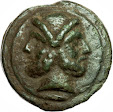
I will post a coin on the next page. That coin is from the first series assigned to Rome and is dated 280 BC, or a century plus before the war with Veii.

What is Money? According to D. B. Holland in "Money in the Late Roman Republic" it is:

Something used as:
Medium of exchange: recognized by many to have value, facilitates trade; examples: land, cattle, sheep, bullion, shells, etc.
Measure of value: to determine equivalent trade value, ie – how many eggs equal a modius of flour
Unit of account: to balance books, determine tax rate, set social standing for senate & army (see below)
Store of wealth, needs to be something that is: “small”, will hold value, will not degrade with time

Means of payment: pay soldiers and other military expenses, pay taxes, buy (luxury) goods from outside community

By this definition, the cast bronze is money and thus worthy of a display at the Money Show! Some early bronze shapes were shown in the flat coin case.

Aes Rude - Molten bronze cooled in water

Broken plates or panes

Aes Formatum – Ingots, bars and pieces
With and without marks, Ramo Seco
Shells

Astralagas, knuckle bones


Broken tools: knife blade, ax
Note the pic below has a piece of a knife blade and two axes.

Decorative Shapes: rings, palmetto, tear drop, bars, acorns, etc.
The shapes are above. Below are some aes rude with marks.


I will post a coin on the next page from the first series issued in Rome. 

Monday, December 24, 2018

Coin from The Bishop's Wife

Steve b - I could not post a reply to your question on the Bishop's Wife, so maybe I can answer here.

A widow's mite is a small bronze coin. We do not know for certain which coin, but the most likely is a Judaean Prutot of Alexander Jannaeus (103 to 76 BC).
you can see examples of Widow's Mites here and below:
https://www.cointalk.com/threads/widows-mite.329382/

A friend from cointalk.com did some research on the coin shown in the Bishop's Wife. It is a bronze coin of Trajan who ruled from January 98 (AD) to August 117 (AD).

https://www.cointalk.com/threads/coin-quiz-from-the-bishops-wife-a-coin-movie-for-christmas.272080/

The obverse legend is "...TRAIANO AVG...AC PM TRP COS V PP"

Looking at Wildwinds, four bronzes are shown which have that legend (there may be more which aren't represented in Wildwinds):

RIC 492
Trajan Æ Sestertius. IMP CAES NERVAE TRAINO AVG GER DAC PM TRP COS V PP, laureate bust right / S.P.Q.R. OPTIMO PRINCIPI, Annona standing left, holding grain ears and cornucopiae; modius with grain ears and prow at her feet; SC. Cohen 469.

RIC 500
Trajan 98-117 AD. AE Sestertius, 27.21 gr. Struck 103-111 AD. IMP CAES NERVAE TRAIANO AVG GER DAC PM TRP COS V PP, laureate head right, slight drapery on left shoulder / SPQR OPTIMO PRINCIPI, S-C Fortuna standing left, holding rudder before prow, and cornucopiae. RIC II 500; BMCRE 797; Cohen 477; Sear (1988) 1008.

RIC 502
Trajan AE Dupondius. IMP CAES NERVAE TRAIANO AVG GER DAC PM TRP COS V PP, radiate bust right / SPQR OPTIMO PRINCIPI S-C, Fortuna standing left with rudder on prow and cornucopiae. Cohen 497.

RIC 571
Trajan AE Sestertius. IMP CAES NERVAE TRAIANO AVG GER DAC PM TRP COS V PP, laureate bust right / SPQR OPTIMO PRINCIPI S-C, View of the Circus Maximus, showing a colonnaded front (the Duodecim Portae), with arched gateways surmounted by quadrigae; temple of Sol along back wall; within, from left to right: meta, equestrian statue of Trajan, obelisk of Augustus, shrine of Cybele, and a second meta. RIC II 571; Woytek 175b; Cohen 545.


Wednesday, October 31, 2018

One Ounce Bronze Commercial Barrel Weight, γA


Late Roman or early Byzantine bronze commercial weight –This weight is probably from the east and after weights with Roman numbers (I for a one ounce) and before only Greek numbers / letters were used. The seller proposed 500 - 650 AD. The weight has a Greek number and Roman letter to mark its weight. I can not tell from the picture if any of the original silvering is still on the weight. Simon Bendall in Byzantine Weights, pg 8, splits scale weights into commercial and coin weights. He then shows symbols for Roman and Byzantine weights. The  γA on this weight is for one ounce = 27.2 grams in theory = one VNCIA (ounce) = 1/12 of an As (Roman pound). One As = 327.45 grams.

Uniface barrel- shaped 1 uncia weight. Cylindrical with a slightly bulging center and with a flat top and bottom. The top bears a center punch flanked by the engraved letters γA = 1 uncia.
nVF, toned with some crust
Diameter = 15- 17mm
Weight = 26.18 g
Bendall numbers 33 & 34

purchased from numismatiklanz, 10/31/2018


Monday, October 29, 2018

Byzantine bronze commercial weight – semuncia


Byzantine bronze commercial weight (from Artemide eLive 5 - Antiquities) – This one is similar to my Roman weights, but it has Greek letters to mark its weight. Simon Bendall in Byzantine Weights, pg 8, splits scale weights into commercial and coin weights. He then shows symbols for Roman and Byzantine weights. The BI on this weight is for one semuncia = 13.6 grams in theory = half an uncia (ounce) = 1/24 of an As (Roman pound). One As = 327.45 grams.

This piece is 15 mm in diameter and 14 g.

I have one other semuncia weight (14.3 grams), but it has no marks. See below.


The weights clockwise from upper left:
6 uncia commercial weight = 154.4 grams
two steelyard weights, left one bronze, right one lead = 24.5 & 27.2 grams
three coin weights, 1 Solidi, symbol N or four dots - 3.9, 4.0 & 4.3 grams
three commercial weights
   3 uncia = 67.8 grams
   1 uncia = 27.1 grams
   semuncia = 14.3 grams


Thursday, October 11, 2018

L. Roscius Fabatus Girl feeding snake - Crawford 412/1


I bought this coin because I liked the symbol pair. I have not seen an ancient scale or balance on a coin or from other sources with these features:
  • ·        Two horizontal beams.
  • ·        An arch below the beams.
  • ·        A base with legs to hold the vertical post that holds the beam. Most coins are held from above the beam by hand.
  • ·        The pan on the right is larger than the pan (weight?) on the left.

It looks a bit like the Nuremberg ducat scale pictured below from Scales and Weights by Bruno Kisch, pg 40. When a gold ducat of low weight was placed in the right pan, the arch showed how many grains the coin was below standard. I have not seen any ancient scale pictures with the arch.  


If someone knows of a reference with a scale like the one below, let me know.


L. Roscius Fabatus Girl feeding snake
Scale and Scale Weight Box Control Symbols

64 BC, Cr412/1

AR Denarius (Serratus); L. Roscius Fabatus;  64 BC Chr., Rome,
Obv - Head of Juno Sospita r. in the goatskin cap that is tied in front, behind balance / scale, below: L.ROSCI; border of dots
Rev - Girl stands r. feeding snake that is raised in front of her, behind box for weights, In Ex: FABATI; border dots
3.94 g
Crawf. 412/1, o/r dies = 240/241
BMC 3474 – this control symbol pair
Syd. 915
RSC / Bab. 1; Note: both books show the scale / box symbol pair.
gVF, well centered and struck, nicely toned, some scratches
On the occasion of the annual festival of Juno Sospita in Lanuvium, a virgin had to feed the snake living in the basement of the temple. If the girl was chaste, she left the cave to much celebrating from her family, otherwise she was killed by the snake.
Crawford notes the die symbols were pairs of related every-day objects. There was no more than one die for each symbol. Bab lists 155 pairs. Grueber lists 108 pairs. Crawford lists 242 pairs.
3.94 g.


Nuremberg ducat scale from 
Scales and Weights by Bruno Kisch, pg 40.

Staedtler 6in plastic protractor with swing arm

Some ancient coins with scales. Mine are the first few.

Egyptian painting from book of dead


quadrans of Claudius
Purchased from Numismatica Tintinna

Follis of Maximinus
purchased from MA Shop Gert Boersma
Roman Republic, MN. CORDIUS RUFUS 46BC
purchased from Ken Dorney

Roman Republic, C. Annius brockage 
purchased from NAC

Roman Republic, C. Piso L.f. Frugi. 61 BC (CNG)

Roman Republic, C. Annius and L. Fabius, 82-81 BC (NAC)

Roman Republic, Q. Metellus Scipio and P. Licinius Crassus Iunior, 47-46 BC (New York Sale)

Similar to mine from CNG


Similar to mine, but scale / modius (a bucket to measure grain) from CNG

Friday, September 21, 2018

A tiny Roman steelyard scale


Roman Steelyard Balance

1st-3rd century AD


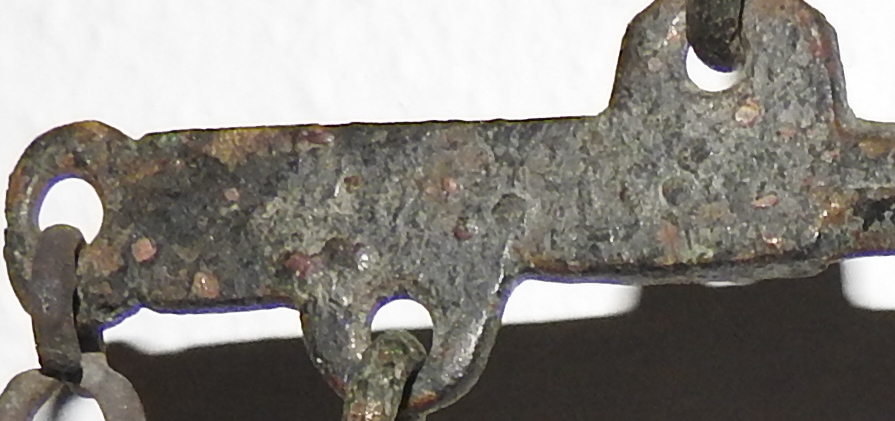
I bought an interesting, and small, Roman Steelyard scale in a recent auction. It was advertised as bronze. It is not magnetic, so I assume bronze is correct. The length of the beam is 150 mm. The seller advertised it as 240 mm. It is 240 mm if you hold the scale by the weighing hook, but it is impossible to weigh items that way. “A steelyard has a beam with unequal arms. The long arm has a weight suspended from it, which is moved until equilibrium is obtained. The load is suspended from the short arm of the beam.1” This scale has two fulcrum points, or weight ranges (low and high). Weight range is switched by rotating the load hook 180o and using the other fulcrum point.
The scale is good but not the best design available in ancient Rome. Scale accuracy is a function of repeatable distances between the fulcrum hanger, load hanger and weight hanger. The most accurate design had load and fulcrum points in the center of the scale arm and used football shaped dowels, see pics below of my small steelyard scale and two different 19th century scales.
The weight range of this scale is indicated by stamped dots or lines on two sides of the scale arm. I could not make a regular pattern on either side. The low weight range scale arm had 14 dots and two lines. The high weight scale arm had only two dots (that I could see for sure) and about 8 lines (again hard to see). In a flat part of the scale arm were several counter stamps. I assume the stamps were some approval of the scale’s calibration. They are hard to see in hand or in pictures, but I guess there are a dozen or more. The counter stamps are not all the same. One looks a bit like PacMan with a wide open mouth.
This scale is a plane jane version. Some scales have decorations. I thought this one might be decorated because the seller mentioned a finial. A finial is an ornament at the top, end, or corner of an object.  See pic below.

I am not sure what would have been measured with a scale this size, but I estimate the max weight would be about 6 US pounds or 3 Kg. I bent the holder of a scale when I attempted to put too much weight (3 asses, or 3 US pounds, including both the weights and some Aes Rude) on a two pan balance about this size.

The seller’s description, modified a bit:
Roman Steelyard Balance. 1st-3rd century AD
A bronze steelyard with impressed point scale, two lateral chains and finial with hook, lead weight with wire hook. 29 grams total, steelyard: 24cm overall (9 1/2"). Note: the overall length is only 150 mm! The extra 90 mm is when the chain and hook are counted as length.
[2 pieces: scale & scale weight]
Condition: Fine condition.
Provenance: Private collection, home counties, UK; acquired before 1980.
TimeLine Auctions; September 4 to 10, 2018: Ancient Art, Antiquities & Coins; LOT 1217

Scale Weight = 26.38 grams
Weight Dia = 17.8 – 18.2 mm
Weight height = 16.2 mm (56 mm including hook)

Scale beam length
15.6 mm from short arm fulcrum to short end
135 mm from short arm fulcrum to long end
150 mm total length

High range scale, short distance from fulcrum hanger to hook for holding item to be weighed
15 mm from short arm fulcrum to weight hook (high weight scale)
135 mm from short arm fulcrum to long end
27 mm from short arm fulcrum to minimum weigh point of long end
Ratio = 135 / 15 = 9.0
Ratio = 27 / 15 = 1.8

Low range scale, long distance from fulcrum hanger to hook for holding item to be weighed
28.9 mm from long arm fulcrum to weight hook (low weight scale)
123 mm from long arm fulcrum to long end
27 mm from long arm fulcrum to minimum weigh point of long end
Ratio = 123 / 28.9 = 4.3
Ratio = 13 / 28.9 = 0.45


Scale Range
Minimum, with one uncia weight that came with scale
Maximum, with one uncia weight that came with scale
Minimum, with one As weight
Maximum, with one As weight
Low, long arm
0.45 uncia = 12 g
4.3 uncia = 120 g
0.45 As = 150 g
4.3 As = 1,400 g
High, short arm
1.8 uncia = 49 g
9.0 uncia = 250 g
1.8 As = 590 g
9.0 As = 2,900 g


scale in high weight range mode

scale in low weight mode, note the scale weight is just the right weight to balance the scale, some scales place a plumb bob on the scale to help detect the balance point

19th century scale

19th century scale

counter marks on side one

counter marks on side two

finial ornament at the top of an Islamic mosque

measuring scale arm


References:
7.      Measuring and weighing in ancient Times, English editor – A. M. Goldstein, Hecht Museum
8.      Pondera, Pesi E Misure Nell’Antichita; Carla Corti & Nicolette Giordani